Recent acquisition
Hercules as a Gladiator
Peter Paul Rubens
Oil on panel · 65.5 × 54.4 cm
Amsterdam Research Centre
Est. 1989 · Amsterdam & Geneva

Dutch & Flemish
Old Masters

Connoisseurship since 1989

One of the world's leading specialists in 16th- and 17th-century Dutch and Flemish paintings. Select acquisitions, scholarly expertise, and curatorial counsel for private collectors and institutions.

View Collection
35+
Years of expertise
TEFAF
Annual exhibitor
Rijks.
Museum clients

What we offer

Select Paintings
A curated inventory of rigorously attributed works, each supported by full provenance documentation and scholarly literature.
Expert Evaluations
Authentication, condition assessment, and market valuation by one of the foremost international experts in the field.
Collection Counsel
Strategic guidance on building, maintaining, and cataloguing a collection — from acquisition through to institutional loan.
Research & Attribution
In-depth archival and art-historical research through our Amsterdam centre, with contributions published in annual catalogues.
Conservation & Framing
Coordination of conservation, restoration, period framing, photography, and specialist shipping worldwide.
Annual Catalogue
Each year, a scholarly publication with contributions by leading art historians — the record of our most significant acquisitions.

The collection

Hercules, Peter Paul Rubens
Hercules as a Gladiator
Peter Paul Rubens
Oil on panel · 65.5 × 54.4 cm
View catalogue entry
A Tronie of a Bearded Old Man in Profile, Facing Left, Jan Lievens
A Tronie of a Bearded Old Man in Profile, Facing Left
Jan Lievens
Oil on panel · 56.3 × 45.8 cm
View catalogue entry
A Young Man Wearing a Turban Holding an Upturned Glass: The Fingernail Test (Allegory of Taste), Michael Sweerts
A Young Man Wearing a Turban Holding an Upturned Glass: The Fingernail Test (Allegory of Taste)
Michael Sweerts
Oil on canvas · 75 × 58.4 cm
View catalogue entry
Self Portrait with a Black Beret, Pieter Verelst
Self Portrait with a Black Beret
Pieter Verelst
Oil on panel · 25 × 20.8 cm
View catalogue entry
Portrait of a Man with a Red Hat, possibly Eitel Friedrich II von Hohenzollern (1452-1512), Swabian School
Portrait of a Man with a Red Hat, possibly Eitel Friedrich II von Hohenzollern (1452-1512)
Swabian School, c. 1482
Oil on panel · 52.5 × 35.5 cm
View catalogue entry
Tronie of a Bearded Man with a Large Beret, Jacob Backer
Tronie of a Bearded Man with a Large Beret
Jacob Backer
Oil on panel · 66 × 51 cm
Signed lower right: JAB (in ligature)
View catalogue entry
Backgammon Players in an Interior, Michael Sweerts
Recent acquisition
Backgammon Players in an Interior
Michael Sweerts
Oil on canvas · 75 × 102 cm
Signed lower centre: MS
View catalogue entry
The Virgin and Child of the Rosary, Peter Paul Rubens
The Virgin and Child of the Rosary
Peter Paul Rubens
Oil on panel · 42.8 × 34.3 cm
View catalogue entry
A Tulip Mania Painting, Jacob Marrel
A Tulip Mania Painting
Jacob Marrel
Oil on panel · 65 × 42 cm
Signed and dated lower centre: I . MARRELLUS . f / 1 . 6 . 35 .
View catalogue entry
The Adoration of the Christ Child with Angels Carrying the Arma Christi, Hans Rottenhammer
The Adoration of the Christ Child with Angels Carrying the Arma Christi
Hans Rottenhammer
Oil on copper · 26.5 × 21 cm
Signed lower right: Gio. / Rottenhamer / Venetia 1601
View catalogue entry
Still Life with a Bread Roll, a Roemer and Oysters, Pieter Claesz
Still Life with a Bread Roll, a Roemer and a Lying Berkemeyer, a Plate of Olives, a Knife, Oysters with Pepper and Salt on a Pewter Dish atop a Table
Pieter Claesz
Oil on panel · 37.1 × 51.3 cm
Signed with monogram and dated lower left: PC 1642
View catalogue entry
Still Life with an Earthenware Jug and a Gouda Pipe, Jan van de Velde III
Still Life with an Earthenware Jug, a Tortoise Shell Tobacco Box, a ‘Gouda’ Pipe, a Glass of Beer and Tobacco Smoking Implements
Jan van de Velde III
Oil on panel · 38.1 × 29.8 cm
Signed and dated 1658
View catalogue entry
Tronie of a Man with a Tall, Fur-Edged Red Cap, Karel van der Pluym
Tronie of a Man with a Tall, Fur-Edged Red Cap
Karel van der Pluym
Oil on panel · 22 × 19 cm
View catalogue entry
View of the Old Stock Exchange at Amsterdam, Job Berckheyde
View of the Old Stock Exchange at Amsterdam
Job Berckheyde
Oil on panel · 23.3 × 17.9 cm
Signed lower right: HBerck heyde f
View catalogue entry
A River View with a Bastion, Fishermen and Shipping, Salomon van Ruysdael
A River View with a Bastion, Fishermen and Shipping
Salomon van Ruysdael
Oil on canvas · 74 × 109 cm
Signed and dated lower right: SvR 1645
View catalogue entry

Research & discoveries

Research lies at the heart of Salomon Lilian. At the gallery’s research centre in Amsterdam, art historians study each acquisition – its attribution, its provenance, its place in the artist’s oeuvre – and publish their findings in the gallery’s annual catalogue, issued since 1992. Their work regularly brings forgotten paintings back to light.

Currently on loan Jan Lievens’ Tronie of a Bearded Old Man is on view in the exhibition Rembrandt 1632. Creation of a brand, Herzogliches Museum, Gotha, until 6 December 2026. Exhibition details

In the press

A painting must be sexy, must appeal to the senses.Salomon Lilian

CODART eZine · Autumn 2016
Salomon Lilian interviewed by Gerdien Verschoor

On learning to look, the first mistakes and the first breakthrough, the touch of a painting, and why Amsterdam can once again be the centre of the trade in Old Masters.

Salomon Lilian is a proud Friend of CODART, the international network of curators of Dutch and Flemish art.

CODART eZine · Autumn 2016

Salomon Lilian interviewed by Gerdien Verschoor

By Gerdien Verschoor · September 2016
Salomon Lilian
Salomon Lilian

Salomon Lilian founded his company, Salomon Lilian Dutch Old Master Paintings, in 1989. It is based in Amsterdam and also has a branch in Geneva. Lilian specializes in paintings by the Dutch Old Masters and publishes an annual catalog with essays about the most important items in his collection. Salomon Lilian became a CODART business sponsor in 2015.

Barely had I crossed the threshold of his business on Spiegelgracht in Amsterdam before Lilian started giving me the first lesson in my life in feeling a work of art. “Just touch that,” he said. “These buttons on this portrait of Cornelis de Vos. Do you feel it? The three-dimensionality of the painting, the material, the paint that is here in the buttons on the canvas. That’s what art is about, as far as I’m concerned: of course it’s about the picture itself and its significance, but above all it’s the material quality that transcends that picture. And just feel the back! It still has the original stretcher and the original nails. Touching a painting like that gives you a gut feeling for it.”

Cornelis de Vos, Portrait of a Woman

In a museum you would …

… never be able to touch that painting. That’s why I’d never want to work in a museum. As a dealer – or a collector of course – you have far more freedom in how you handle your works of art. And that physical contact, that touch, is something I find particularly important. And this too, for instance. [produces cotton pads and a bottle of turpentine and casually wipes clean the surface of a new purchase, The Backgammon Players by Willem Duyster.] Just look at the three-dimensionality that suddenly leaps out at you! That’s another big difference from a museum, of course: as an art dealer you put your own money into a painting; time and again you take a big risk, so you have to be confident you know who painted it, and how.

You were originally destined to follow in your father’s footsteps as an optician. It is remarkable that although you eventually chose a different profession, it was one in which looking is so important.

It’s true. My father had an optician’s shop and he suddenly died when I was nineteen. So I qualified as an optician as quickly as possible and took over the business. But I soon realized that this was not my calling. It was through the antiques firm of my mother’s family, the Stodels, that I first became inspired to study art history. Those were very tough years, dividing the week between working at the optician’s and studying. Looking back, I think it’s a pity I had so little time for real student life, and never joined a fraternity, for instance.

Did you know from the outset that you would focus on the Old Masters?

Yes, that was clear from the beginning. Mainly through the Stodels’ influence, but then I met Rob Noortman quite early on, and he encouraged me to stay focused on the Old Masters. In 1990 I got a credit starter loan from the bank and the government, which enabled me to set up my own business. It was incredibly hard at the beginning. The art trade is very closed; people don’t like newcomers, so they mess you around, and you have to be able to take it. And I had zero experience. So I started off with two major mistakes. My first purchase was a Winter Landscape by Gerrit van Battem, which I bought for 30,000 guilders. When I took the painting to the conservator he gave me my first lesson in looking – unfortunately it turned out that the entire sky section had been painted with new, twentieth-century paint. I was eventually able to sell the painting, but I had to accept a loss.

So your credit went up in smoke.

Yes, and after that I made another, similar, mistake, with a Seascape by Pieter Mulier the Elder. That painting turned out to have been cut down. Today I’d see that straight away, from the traces of sawing and from the composition, but as I said, I was still learning how to look. Still, I did learn – by trial and error.

When did you have your breakthrough?

It was at the 1991 PAN art fair, where Salomon Stodel had given me wall space to hang my Old Masters, that I met Rob Noortman, who offered to help me. I had discovered a painting by Pieter Claesz, which Noortman and I purchased for 100,000 guilders and Noortman sold for over a million. So then I could get moving. We bought and sold several other paintings together, and then in 1992 I was given my own stand at the PAN, I met clients, went to TEFAF, and the business really took off. Art fairs obviously have tremendous added value, since they enable you to reach a wide international public in one fell swoop.

You mentioned the errors you made at the start of your career, about learning how to look. We hear it said more and more often, that university students don’t learn how to look.

It’s true. The practice of looking still receives little attention – let alone the idea that students would ever be allowed to touch a painting. How many hours does the average student spend at museums, art fairs, private art galleries, with real paintings? Who teaches them to look at artworks and draw their own conclusions? I found it exciting to see Fritz Koreny doing just that at CODART NEGENTIEN in Madrid. You may not always agree with his conclusions, but even so: it was a fantastic lesson in looking.

Perhaps art dealers like you should give guest lectures at universities. To keep young people connected to the Old Masters.

Well I’ve never thought about it, but it would be interesting, teaching students much more about the everyday practice of looking at artworks. I do that now, but in a different way: I hire young art historians and train them. What they bring the firm is an enormous amount of expertise, and what they learn here is how to look. Without someone like Jasper Hillegers, who has been working for me since 2010 and was recently also appointed curator at the Frans Hals Museum, we would never have been able to identify the subject in Pickenoy’s portrait. His academic approach opened my eyes. Collaboration with scholars is essential to the art trade – I consider it crucial to the significance of my work to ensure that we can provide that depth of knowledge about every painting.

Nicolaes Eliasz. Pickenoy, Portrait of Dirck van Dans

You belong to the younger generations of art dealers, but now a new generation is making its presence felt.

Yes, some interesting young people have appeared in the art trade who have a really good eye. Jan Six, whose firm is affiliated to Hazlitt, Gooden & Fox in London, is based in Amsterdam, and so is Niels de Boer, of the art gallery P. de Boer. I hope that Sander Bijl will also come to Amsterdam. Now that older dealers in London, such as Johnny van Haeften, are retiring, and people like Richard Green are buying fewer Dutch Old Masters, there is plenty of momentum – and Brexit has reinforced this trend – to restore Amsterdam’s position as the center of trade in Old Masters. The reopening of the Rijksmuseum has also provided a tremendous impulse, attracting far more potential clients, including some from China. We’ve left the dark days behind us: a new era has dawned.

Detail of the Portrait of Dirck van Dans by Pickenoy
Nicolaes Eliasz. Pickenoy, Portrait of Dirck van Dans (detail)

A new era – but all the art dealers are men!

Yes, I have no idea why women don’t venture into this field. You must have a good eye, be able to make purchases, but you also have to have good business sense, to have a good grasp of all the fiscal and accounting aspects of your company. We’ve certainly seen a whole new generation of women curators establish themselves, so it’s a mystery to me why we don’t see them in the art trade. Perhaps it really is a question of daring?

Have you noticed any other new trends?

Yes, in two areas. First of all, there’s a new generation of younger collectors, particularly in the US. Last year I sold a painting for the first time to collectors who usually only buy modern art. Old Masters are cheap in comparison to modern and contemporary art, and you see bankers and hedge fund managers getting interested in investing in Old Masters. There are also a lot of potential clients in Asian countries: people who see that Old Masters are cheap now and that the prices will rise. When the Leiden Gallery starts putting on exhibitions in the Far East, as Tom Kaplan plans to do, when people over there see that you can buy ten Rembrandts in the space of ten years – that will change the market.

What about content?

For a dealer it’s important to find artworks that fit the Zeitgeist. Why is contemporary art all the rage right now? Because it hits you – wham! – really directly. Cabinet paintings demand a completely different approach to looking: you have to go right into the painting, as it were: you have to make an effort, and it requires more knowledge, which people often don’t have nowadays. Still, paintings by Old Masters that make a gesture, that reach out to you in a sense, much as contemporary artworks do – works like that are starting to stir up more interest among collectors, including new ones. People want paintings that have an immediate impact. As a dealer you have to dare to acknowledge that and go in search of paintings like that. The Duyster is an example of that, and so is The Owl by Dirk Valkenburg, which I presented at the TEFAF in March.

Dirk Valkenburg, The Owl

How do you see the curator’s role here?

A good example was the exhibition The Discovery of Everyday Life: From Bosch to Bruegel at Museum Boijmans Van Beuningen last year. Every painting there looked really contemporary: they were all striking images. The exhibition was framed by a good narrative and it was accompanied by an excellent, in-depth catalogue. In my view, that belongs to the core tasks of today’s curator. Curators must try to get the public engaged in that knowledge by telling an interesting story.

“The beautiful is secret” was the title of Peter Hecht’s valedictory lecture. That may be so, but that does not absolve us art historians of the duty of setting out to illuminate artworks. Can you illuminate the most beautiful paintings here on Spiegelgracht? Or is the essence of their beauty, for you too, a secret?

I can articulate what it is that makes a painting “beautiful” in my eyes. A painting must be sexy, must appeal to the senses. That may come from its chiaroscuro or from a loose, vigorous style of painting – it has to have a certain tension that is difficult to put into words. Take the first painting you touched this morning: those buttons, that material, and the sky, they all add real excitement to the painting. Or this Portrait of Dirck van Dans by Pickenoy: he meets our gaze with such self-assurance. Marvelous! But to my mind, this Lievens, Saint Simeon and the Christ Child, is another example. Lievens signed the painting with his Latin name, “J. Livius,” so he was really proud of it. It is actually more suited to a museum than the art trade, with that strange rather unattractive Christ Child and Simeon’s bad teeth. But it has precisely that tension I was talking about, and someday I’ll find a good home for it.

Jan Lievens, Saint Simeon and the Christ Child

This interview was originally published in the CODART eZine, no. 8, Autumn 2016, and is reproduced here with the kind permission of CODART. Read it on the CODART website →

Two cities, one eye

Amsterdam
The Netherlands · Research Centre
Spiegelgracht 5
1017 JP Amsterdam
By appointment · Historic Canal District
Geneva
Switzerland · Gallery
Rue Verdaine 6
CH-1204 Geneva
By appointment · Old Town
Telephone +33 627 812 629
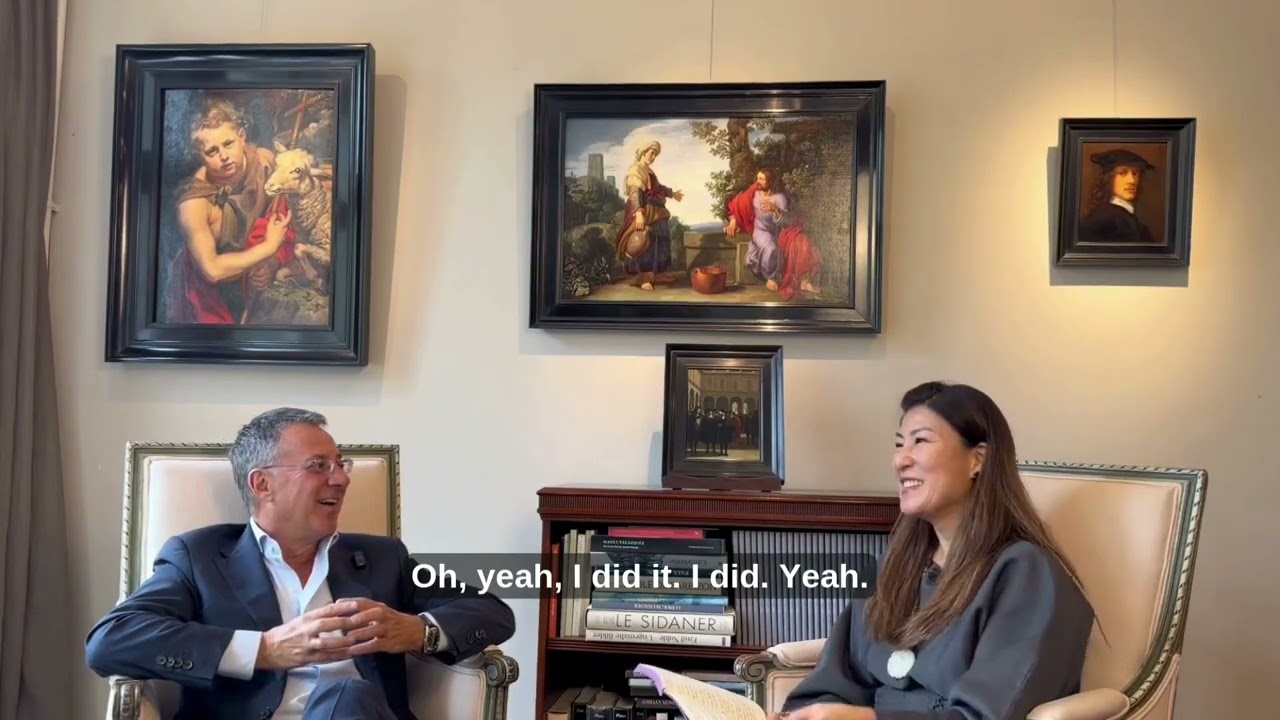
Film
Inside Salomon Lilian Gallery

Step inside the gallery with 5000 Years Academy, and meet the paintings and the people behind them.

Watch on YouTube Follow us on Instagram
Salomon Lilian · Amsterdam & Geneva

Request a consultation

Whether you wish to acquire a painting, sell or consign a work, or seek an opinion on attribution, we will be glad to arrange a private meeting in Amsterdam or Geneva, or to speak by telephone.

Opens your email application with your request addressed to salomonlilianoldmasters@gmail.com.

Privacy notice: The information you provide is used solely to respond to your enquiry. It is never shared with third parties and is not kept longer than necessary. You may ask us to access or delete your data at any time by writing to salomonlilianoldmasters@gmail.com.

Or call Salomon Lilian +33 627 812 629